Please read about the exclusion of Mathematics from the Highly Cited Researchers list in 2023, and its return in 2025, or continue to my regular "index.html".
Igor Podlubny
In 2023, Clarivate™ excluded the field of mathematics from their Highly Cited Researchers lists. In May 2024, I have described this in my preprint arXiv:2405.19872.
In October 2025, a paper by I. Agricola et al. appeared in the Notices of the American Mathematical Society, titled "Fraudulent publishing in the mathematical sciences", analysing this exclusion.
Clarivate returned the field of Mathematics to their HCR lists published on November 12, 2025, with an explanation provided in the FAQ section (https://clarivate.com/highly-cited-researchers/faqs/).
“This year we are reintroducing the Mathematics category after an absence of two years. There are 60 researchers named in Mathematics in 2025.”
Tidying up the list of 60 mathematicians can be done even manually, especially because of the medialization of the previous removal of the field of Mathematics from the HCR list. However, it looks like there is still a lot of headroom for improvement.
Let us start with how the HCR 2025 list looked originally after it was officially released — here is the video (without narration).
Selecting “Mathematics” in the HCR list produces the list of 65 names – not 60 names, as Clarivate informed – of which 48 names are listed with the “View profile” links to their personal profiles at the Web of Science. However, 17 names are listed with the “Claim profile” links, which means that the authors did not confirm that those profiles and those publications are theirs.
This means that 26% of the HCR list for Mathematics does not have a verified identity at the Web of Science. This is in contradiction with the introduction and use of authors’ identifiers, such as Web of Science ResearcherID (former Publons), or ORCID. The affiliations can change, but the author’s identity should remain the same. To make a correct list of publications and citations in the Web of Science across several primary and secondary affiliations over their careers, the authors have to merge the corresponding data in their personal profiles in the Web of Science, and this can be done only by them after logging into their accounts at Web of Science.
It should not be a problem to contact, for example, Emmanuel Candes or Peter Scholtze, and ask them to create or verify their Web of Science profiles (which they still do not have as of January 28, 2026). Clearly, every researcher listed in the HCR list must have a verified profile.
Additionally, even the “View profile” link sometimes produces questionable output.
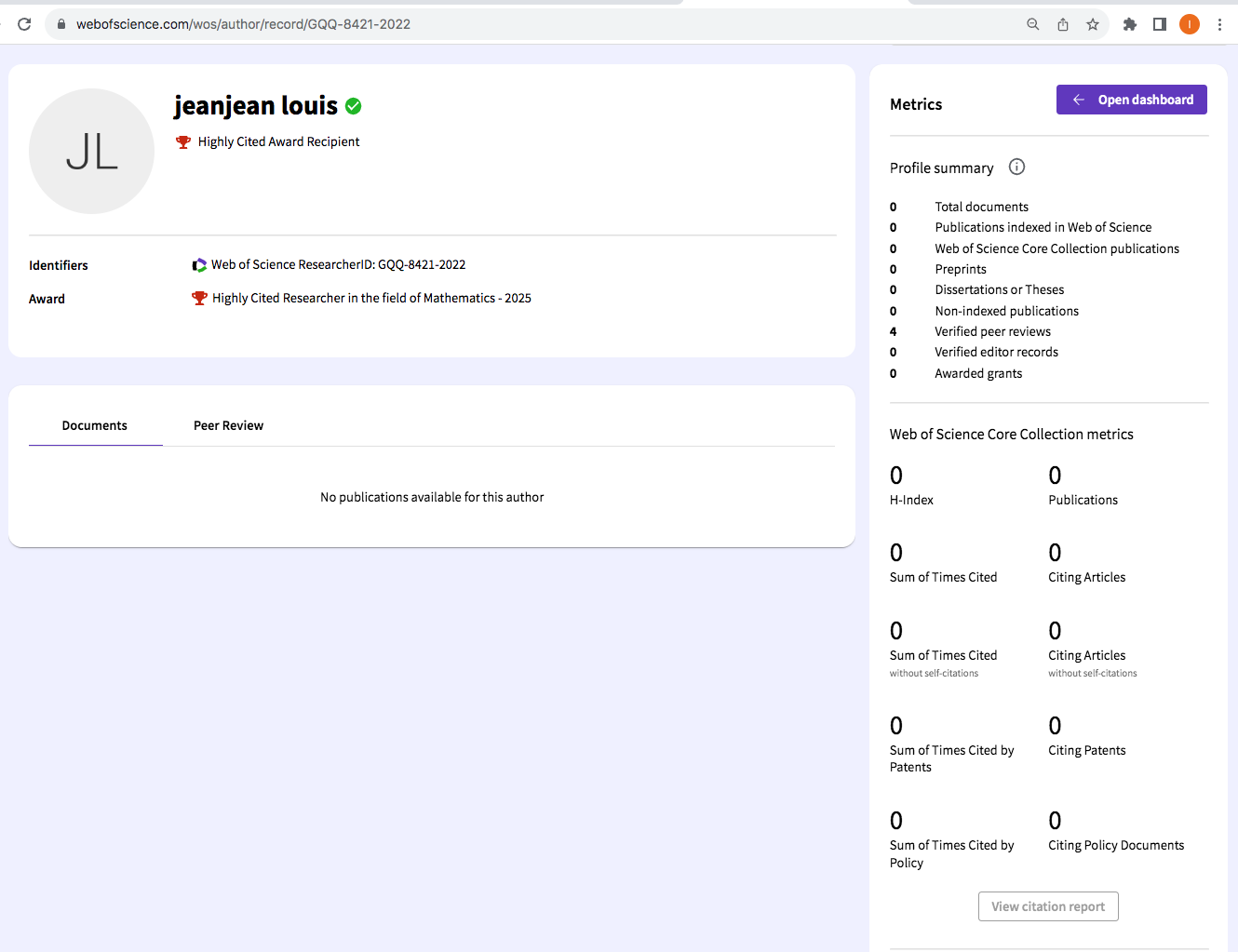
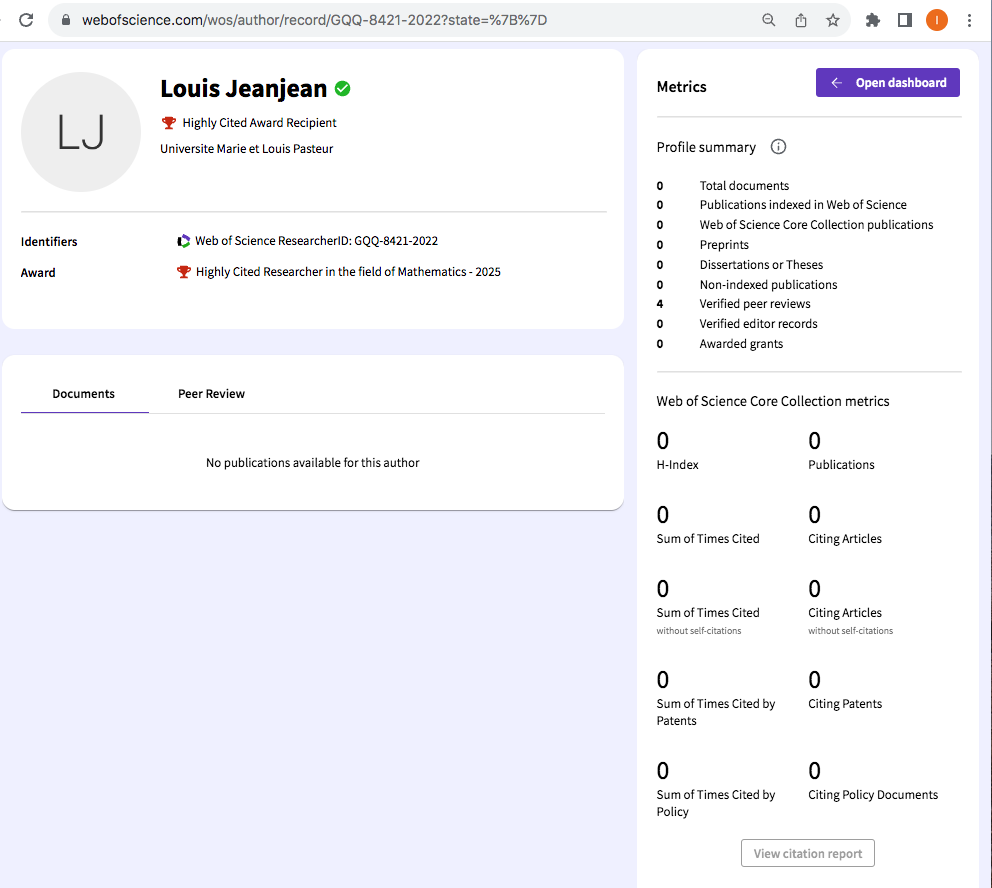
The first example is Louis Jeanjean. In the screenshot made on November 17, shown in Fig. 1, the name is written using only lowercase letters, there is no affiliation provided, and all publication and citation numbers are zero – and that all is strange. In the screenshot made on December 8, shown in Fig. 2, the name is capitalized, some affiliation is added, but but the numbers of publications and citations are still all zero.
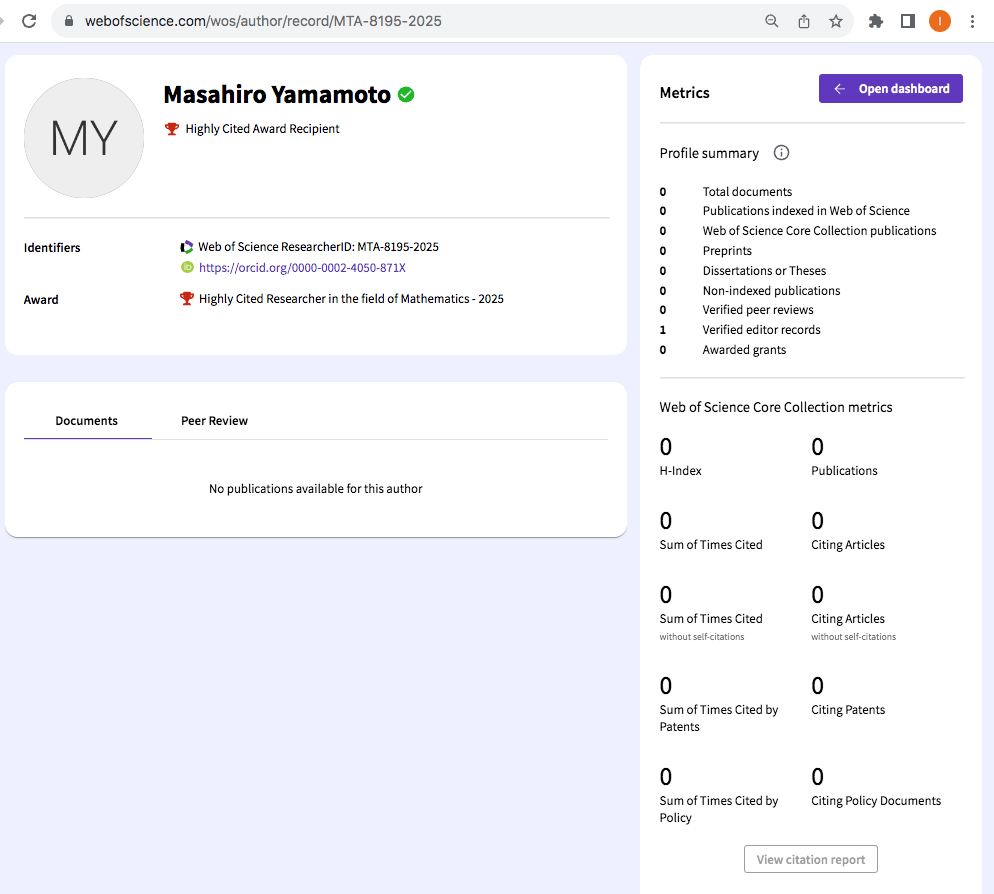
The second example is Masahiro Yamamoto. In the online list, published by Clarivate, his affiliation is listed as “Romanian Academy, Romania”. However, there is not such institution, and the only similarly looking name is “Academy of Romanian Scientists”, which is not an institution, but a learned society. The link “View profile” leads to the profile shown in Fig. 3, without affiliation, and with zero papers.
The search for Masahiro Yamamoto (and for Yamamoto Masahiro) in the Web of Science produces the list of 48 researchers. Two of them are HCRs, but they are not mathematicians. Three of those 48 are mathematicians, but they are not denoted as HCRs. It is not clear which one appears in the Clarivate’s list of HCRs.
Both cases are unverifiable, and this is not the way of presentation of the persons who Clarivate identified as highly cited mathematicians.
This question arises as we notice that a mathematician Masahiro Yamamoto from the University of Tokyo is a member of previously mentioned “Academy of Romanian Scientists” (see https://www.aosr.ro/membrii-sectiei-stiinte-matematice/). There is an unclaimed WoS profile with the ResearcherID OZT-6798-2025, with seven papers denoted as highly cited papers, where in the list of affiliations we see also “Academy of Romanian Scientists” Is this the correct Masahiro Yamamoto?
If yes, then it is unclear why a researcher with a Slavic name from Germany, the regular co-author of Masahiro Yamamoto with the ResearcherID OZT-6798-2025, is not included in the list of HCRs despite having twelve highly cited papers including three highly cited papers with Masahiro Yamamoto.
It is worth mentioning that, in general, the 2025 HCRs list does not contain researchers with names sounding Slavic or East European.
Clarivate did not change the methodology for compiling the 2025 list of HCRs. They are still counting the “beans” – “highly cited papers”, which are the papers that received some number of citations exceeding the thresholds. And the thresholds for Mathematics are really low: to be marked as a highly cited paper, 3 citations are sufficient for paper published in 2025; 9 citations for a 2024 paper; 19, 30, 42, 56, 64, 74, 77, 81, 92 citations for papers published in 2023, 2022, 2021, 2020, 2019, 2018, 2017, 2016, 2015, correspondingly.
This led to including in the 2025 list of HCRs a group of nine principal developers of the deal.II finite element software library, who all are co-authors on a series of eight papers – one paper describing the design and features, and seven papers describing the improvements of the library (for versions 8.5, 9.0, 9.1, 9.2, 9.3, 9.4, 9.5), all with similar abstracts: “This paper provides an overview of the new features of the finite element library deal.II, version [number]”.
Note that 9 names out of 65 means 14%. Does this mean that mathematicians are pushed towards very questionable “large collaborations” known in physics, medicine, pharmacology, and some other fields? Just consider that the complete list of contributors to deal.II currently contains 13 principal developers, 4 developers emeriti, and 418 contributors (see https://dealii.org/community/team/).



I have written the above text on December 2025. About a week later, on December 21, I have noticed that the HCR 2025 list has been silently updated, and the links to “View profile” and “Claim profile” have been removed – compare the screenshots Fig. 4 and Fig. 5. After this change, it became impossible to check out the profiles of the highly cited researchers in the Web of Science.
Here is the video from December 21, 2025.
Further, on January 8, 2026, I have noticed that the non-existent “Romanian Academy” is listed as Yamamoto’s second affiliation, and the primary affiliation “University of Tokyo” has been added (Fig. 6). By this silent update, Clarivate in fact clarified the case of Masahiro Yamamoto in agreement with what I have written earlier in Section 2 and in Section 3.
Even more: the original “View profile” link for Masahiro Yamamoto led to the profile of a material scientist with the same full name at the Konan University in Japan; I do not have a screenshot, but this has been noticed also by Fatiha Alabau-Boussouira (see: https://retractionwatch.com/2025/11/12/math-is-back-as-clarivate-boosts-integrity-markers-in-highly-cited-researchers-list).
Then it remains indeed unclear why the co-author of Masahiro Yamamoto, who has twelve highly cited papers compared with Yamamoto’s seven highly cited papers, is not included in the HCR 2025 — in contradiction with the Clarivate’s methodology.
We see that:
17 names (26%) out of the total 65 did not have verified Web of Science profiles with claimed publications at the time of publication of the HCR 2025 list;
there were two names with zero publications and zero citations in their Web of Science profiles;
a group of nine researchers (14%) share eight papers on the regularly updated versions of a software package that they maintain;
the 2025 HCRs list does not contain researchers with names sounding Slavic or East European;
the ongoing silent updates of the HCR 2025 list, including the removal of the “View profile” links, show that, indeed, this list was not curated properly.
The 2025 list of highly cited researchers in the field of mathematics is clearly very far from what it eventually could be.
Igor Podlubny
February 05, 2026